
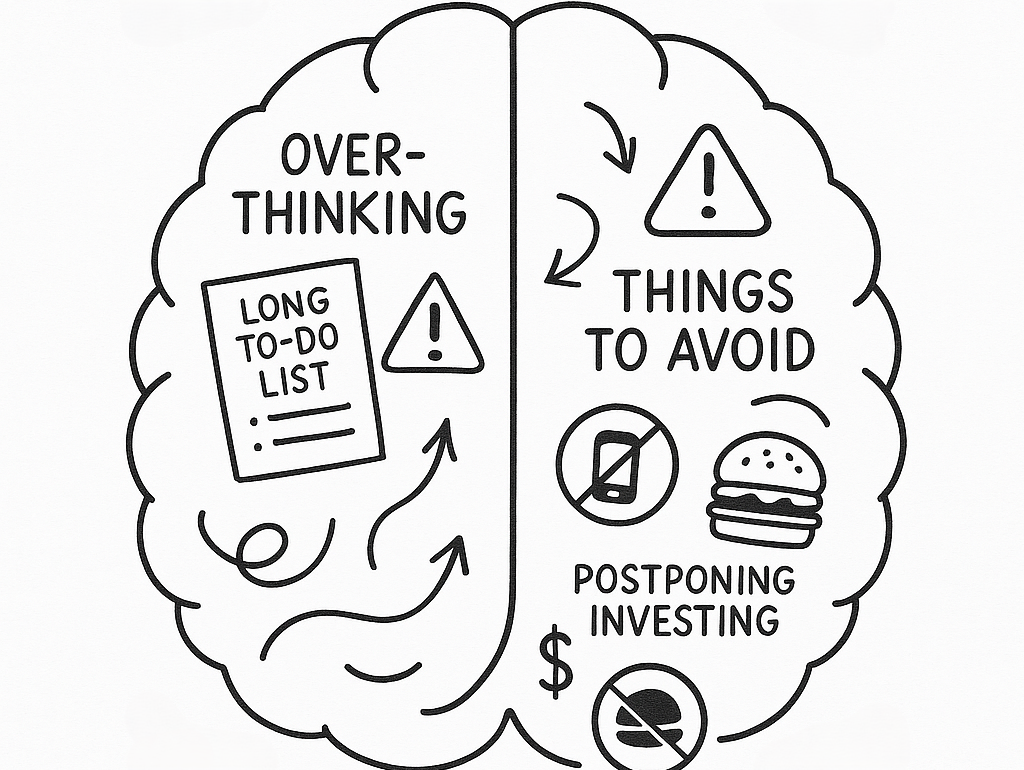
Planned a goal recently? Then you know how the goal setting process goes. We begin by listing what to do. Say your goal is to become fit, your to-do list might look like this.
- Get up early
- Eat healthy
- Exercise daily
- Walk 10k steps
- Increase protein intake
- and so on.
Reaching your goals is a lot of work. And most of the time, we fall short. Contrary to what most of us think, it is not just self-control — it is built in mental defaults. Our brain prefers conserving energy and always switches to default. If your default is late sleep or unhealthy eating, then that is what the brain will choose.
So, if the traditional goal planning process of listing things that you have to do is not very effective, then how can you reach your goals?
Want to reach your goals? Do this instead.
Try anti-goals — a list of things to avoid that speed up progress. Instead of just focusing on tasks that we have to do, we invert the approach and identify things or behaviours that are stopping us from reaching our goals. This idea comes from Charlie Munger’s mental model of inversion. As Munger puts it:
By Stupid Munger means the unhelpful behaviors or poor decisions that derail our progress.
Anti-goals – Avoid doing stupid things:
Let us say you want to retire early. This is how your anti-goals list would look like:
- Stop spending more than you earn
- Don’t upgrade your car every 3 years
- Stop buying stuff you don’t need
- Don’t delay investing
Listing actions that you should avoid doing removes friction and keeps your goal on track.
And this is why it works:
Negative habits have more pull than the new positives we try to adopt. Forming new habits requires energy; the brain prefers defaults. Since harmful behaviors are already automatic, removing them often produces faster gains than adding new routines. That is exactly what anti-goals are about – eliminating unhelpful behaviors that impedes our goal progress.
Next time you plan for a goal, instead of beginning with ‘What should I do to reach this goal’, try asking yourself ‘What should I stop doing to reach this goal’. And stop doing those things.
Should you stop setting SMART goals altogether?
Absolutely not. Think of anti-goals as supplement to your main strategy. It is not a replacement; it is there to speed up the process of becoming a better version of yourself and staying that way. Traditional SMART goal planning has its advantages – it helps you quantify, visualize and solidify your goal. Use anti-goals in conjunction with regular goal planning.
Once you start subtracting things or activities that are not beneficial to you in the long run, the effect of your efforts towards building positive habits is going to be multiplied.